Giraffe Pen Holder STL: Evaluating Design, Utility, and Print Viability
Organizing a workspace often requires balancing strict functionality with personal aesthetic preferences. For makers and 3D printing enthusiasts, the Giraffe Pen Holder STL represents a specific intersection of these needs, offering a safari-inspired desk organizer that serves as both a storage solution and a decorative object. Unlike generic cylindrical cups or modular grid systems, this animal-themed design introduces organic shapes and character to office environments, study areas, and classrooms. However, selecting a novelty desk accessory involves more than just visual appeal; it requires an evaluation of printability, dimensional utility, and long-term durability. Understanding the specific attributes of this STL file helps potential users determine if it aligns with their organizational goals and printing capabilities.
Defining the Giraffe Pen Holder STL
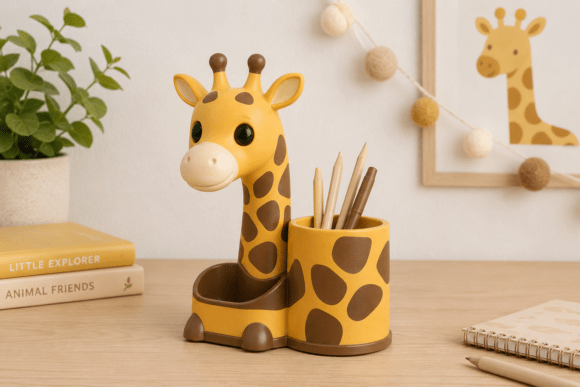
The Giraffe Pen Holder STL is a digital 3D model file designed for additive manufacturing. It translates the silhouette of a giraffe into a functional vessel capable of holding writing instruments, markers, brushes, and small stationery items. The design typically features a hollowed torso or neck section that acts as the primary storage compartment, while the legs and base provide stability. This specific category of desk organizer falls under "functional art," where the form factor is dictated by the biological shape of the animal rather than pure geometric efficiency.
For those researching desk organization solutions, this STL offers a distinct alternative to mass-produced plastic or metal organizers. Because it is a digital asset, the end-user retains control over material selection, color, scale, and infill density. This customization allows the object to be tailored to specific desk themes, such as a natural wood-tone PLA for a professional study or bright multi-color filaments for a child’s room. The referenced final images of printed models serve as a critical benchmark, demonstrating layer adhesion, surface finish, and actual capacity, which are vital factors when evaluating whether the digital design will translate successfully to physical reality.
Evaluating Functional Utility and Capacity
When considering the Giraffe Pen Holder STL for daily use, objective assessment of its storage capacity is necessary. Animal-shaped organizers often sacrifice internal volume for external aesthetics. Users must evaluate the diameter and depth of the storage cavity against their intended inventory. While excellent for standard pens, pencils, and thin markers, the tapered anatomy of a giraffe may limit compatibility with bulkier items like highlighter sets, scissors, or large paintbrush handles.
Key considerations for utility include:
- Vertical Clearance: Ensure the height accommodates longer tools without causing top-heaviness.
- Base Footprint: Assess whether the leg span fits within available desk real estate compared to compact cup-style holders.
- Weight Distribution: Evaluate if the model requires additional weighting (such as sand-filled bases) to prevent tipping when fully loaded.
- Accessibility: Determine if the opening angle allows for easy retrieval of items at the bottom of the holder.
For users requiring high-density storage for extensive art supplies, this design may function better as a secondary holder for frequently used items rather than a primary catch-all. Conversely, for minimalist setups or teacher desks where only a few essential tools are needed, the capacity is likely sufficient and the reduced footprint becomes an advantage.
Printability and Technical Considerations
The viability of the Giraffe Pen Holder STL depends heavily on the user's printer calibration and post-processing willingness. Organic shapes present different challenges than rectilinear functional prints. Evaluating the mesh quality before downloading or purchasing is a prudent step. A well-optimized STL for this type of model should feature smooth curvature to minimize visible layer lines and strategic geometry to reduce the need for support structures.
Supports can be problematic for decorative desk accessories because removal often leaves scarring on visible surfaces. Makers should examine preview slices to identify overhang angles. If the giraffe’s neck or head extends beyond 45 degrees without self-supporting geometry, significant post-processing may be required to achieve a clean finish. Additionally, wall thickness is a critical structural metric. Thin extremities, such as legs or ossicones (horns), are prone to breaking during support removal or daily handling. Verifying that the STL maintains adequate shell thickness in these stress points ensures the final print is durable enough for active use rather than being purely ornamental.
Aesthetic Integration and Audience Fit
Beyond mechanics, the decision to print this organizer is largely contextual. The safari theme makes this STL particularly relevant for specific demographics and environments. In educational settings, such as elementary classrooms or tutoring centers, animal-themed decor can create a welcoming, less sterile atmosphere. For home offices, it serves as a conversation piece that softens the technical appearance of monitors and peripherals. It also functions effectively as a personalized gift, where the ability to print in a recipient’s favorite color adds sentimental value that store-bought alternatives cannot match.
However, aesthetic alignment is subjective. In highly corporate or minimalist industrial workspaces, a stylized animal figure may clash with existing decor. Users should objectively assess their current environment's color palette and design language. If the goal is seamless integration, neutral filaments like matte white, grey, or wood-filled PLA tend to adapt better to varied interiors than glossy primary colors. The "clean decorative style" mentioned in product descriptions suggests a focus on smooth surfaces over hyper-realistic textures, which generally aids in maintenance; smooth prints are easier to dust and wipe down than textured ones that trap grime.
Comparing Alternatives and Making the Decision
Determining whether the Giraffe Pen Holder STL is the right choice involves comparing it against other organizational options. Standard geometric pen cups maximize volume-to-footprint ratios and are faster to print due to simple perimeters. Modular systems like Gridfinity offer superior scalability and interoperability but lack decorative character. Custom lithophane or vase-mode prints offer different aesthetic benefits but often lack structural rigidity for heavy tools.
This giraffe organizer occupies a middle ground. It is best suited for users who prioritize personality and thematic consistency over maximum storage density. It is a strong fit for:
- Makers seeking a test print for organic modeling or vase mode techniques.
- Individuals organizing kids' spaces or creative studios where whimsy is valued.
- Gift creators needing a low-cost, high-perceived-value item.
- Safari enthusiasts wanting cohesive desk theming.
Alternatives should be considered if the primary constraint is desk space, if the user lacks experience removing supports from delicate prints, or if the intended tools exceed the dimensions of the giraffe’s internal cavity. Ultimately, the Giraffe Pen Holder STL is a specialized tool for workspace personalization. By weighing the tradeoffs between organic form and functional storage, and by verifying technical print requirements against personal skill levels, users can make an informed decision that enhances both the utility and enjoyment of their workspace.