Evaluating the Fluffy Hamster Pen Holder Planter STL for Desk Organization and Decor
When selecting functional desk accessories that also serve as decorative elements, 3D printing enthusiasts and organizers often weigh aesthetic appeal against practical utility. The Fluffy Hamster Pen Holder Planter STL represents a specific niche within this category: kawaii-inspired functional art designed for FDM printing. Unlike standard geometric organizers or rigid character models, this design attempts to simulate a soft, tactile texture through digital geometry while maintaining the structural integrity required for holding stationery or small plants. For adults managing creative workspaces, study areas, or children’s rooms, understanding the specific trade-offs of this textured model compared to smooth alternatives is essential for making an informed printing decision.
Design Distinctions and Functional Versatility
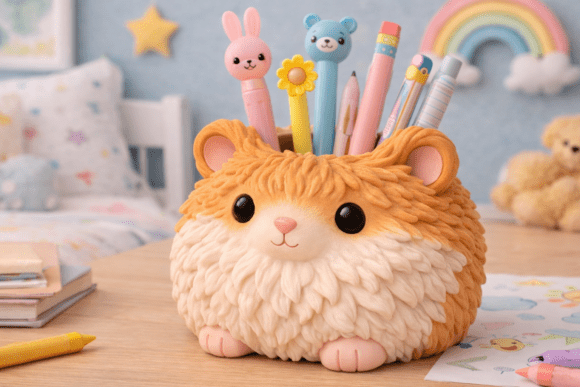
The primary distinction of the Fluffy Hamster Pen Holder Planter STL lies in its surface topology. Most 3D printed desk organizers utilize smooth walls to minimize print time and material usage. This model, however, employs a sculpted "fluff" effect created through overlapping spherical or organic geometries. This approach serves two purposes: it visually communicates softness and playfulness without requiring post-processing textures, and it increases the wall thickness, potentially adding durability to thin sections that might otherwise be fragile on a cute character model.
Functionally, the design operates as a hybrid vessel. The central cavity is sized to accommodate standard writing instruments, markers, and small paintbrushes, but it is equally viable as a planter for succulents or air plants. This dual-purpose nature differentiates it from single-use pen cups. When evaluating this STL, users should consider their primary intent. If used as a planter, the increased surface area of the fluffy texture may retain more moisture or dust than a smooth vessel, which requires specific maintenance considerations. As a pen holder, the textured interior provides natural friction that can prevent lightweight pencils from sliding around, a subtle functional benefit over polished cylindrical holders.
Comparing Textured Kawaii Models to Standard Organizers
When comparing the Fluffy Hamster Pen Holder Planter STL to other desk organization options, several factors emerge regarding efficiency, aesthetics, and printability.
Aesthetic Impact vs. Print Efficiency
Standard modular desk organizers, such as hexagonal grids or minimalist cylinders, prioritize volume-to-material ratios. They are utilitarian and fast to produce. In contrast, the fluffy hamster design sacrifices print speed for emotional resonance and visual interest. The complex surface geometry increases the total path length for the extruder, resulting in longer print times and higher filament consumption. For users who value workspace personalization and mood enhancement over pure utility, this trade-off is often acceptable. However, for those needing high-volume storage or rapid prototyping of organizational tools, a smoother, parametric design may be more appropriate.
Character Models vs. Functional Hybrids
Many kawaii desk accessories are purely decorative statues with no storage capacity, or they are simple boxes with a flat character face applied to the front. The Fluffy Hamster Pen Holder Planter STL integrates the function into the form; the storage space is the body of the character itself. This integration creates a more cohesive object that feels less like a novelty item and more like intentional furniture. Compared to generic animal-shaped holders, the specific "fluffy" styling offers a unique tactile suggestion that appeals to fans of soft aesthetics, distinguishing it from the hard-edged low-poly or voxel-art styles common in free STL repositories.
Technical Considerations for FDM Printing
While marketed as beginner-friendly, the success of printing the Fluffy Hamster Pen Holder Planter STL depends heavily on printer tuning and material selection. The organic shapes are generally forgiving of minor layer adhesion issues, but they present specific challenges distinct from smooth-walled vessels.
- Support Strategy: Depending on the specific orientation of the STL, the tiny paws and the curvature of the fluffy body may require supports. Users must evaluate whether their slicer’s tree supports can handle the intricate surface details without leaving significant scarring. Orienting the model upside down (opening facing the build plate) often eliminates the need for internal supports but requires careful consideration of bed adhesion for the outer rim.
- Layer Height Selection: To preserve the definition of the fluffy texture, a lower layer height (0.12mm to 0.16mm) is typically recommended over the standard 0.2mm. While this increases print time, it prevents the "stair-stepping" effect that can make organic textures look mechanical rather than soft.
- Infill and Wall Count: Because the exterior geometry acts as part of the structural shell, increasing wall perimeters is often more effective than increasing infill percentage. Three to four walls provide sufficient rigidity for holding heavy markers or soil-filled plants without wasting material on internal infill that contributes little to the external shape.
- Material Compatibility: Matte PLA or silk PLA tends to enhance the fluffy illusion better than glossy standard PLA. Glossy filaments can create specular highlights that flatten the perceived depth of the texture, making the hamster look plastic rather than soft. Wood-filled or stone-filled PLAs can also add weight and a premium feel suitable for adult workspaces.
Assessing Fit: When This Model Is the Right Choice
Determining whether the Fluffy Hamster Pen Holder Planter STL is the correct resource for your needs involves analyzing your environment and user base. This model excels in specific contexts where emotional connection and gentle aesthetics are prioritized alongside basic organization.
Ideal Use Cases:
- Kids’ Rooms and Classrooms: The non-threatening, rounded design makes it safe and appealing for younger users. It serves as an engaging tool to encourage tidiness without feeling institutional.
- Creative Workspaces: Artists, writers, and designers often benefit from desk objects that stimulate positive affect. The playful nature of the hamster can serve as a micro-break for the eyes during intensive screen work.
- Gift Giving: For hamster lovers or fans of kawaii culture, this functional gift carries more thought than a generic store-bought organizer because it combines personal interest with daily utility.
- Beginner Skill Building: For new 3D printer owners, this model offers a manageable challenge. It introduces organic slicing settings and support management without the complexity of mechanical assemblies or tight tolerances found in engineering-focused prints.
Situations Requiring Alternatives:
- High-Density Storage Needs: If you need to store dozens of pens, rulers, and scissors, the single-compartment design of the hamster will be insufficient. Modular grid systems or multi-cup organizers offer superior spatial efficiency.
- Professional Corporate Environments: While workplace norms are evolving, some conservative office settings may not align with overtly cutesy decor. In these cases, textured geometric vases or abstract organic shapes provide similar 3D printing interest without the character-specific aesthetic.
- Wet Plant Usage: If intending to use this directly as a planter with wet soil and drainage, verify that the STL includes a drainage hole or is watertight. Many decorative pen holders are not sealed against moisture. For serious gardening, a dedicated planter STL with proper horticultural features is safer than adapting a pen holder.
- Rapid Production: If you are printing items for a craft fair or bulk classroom distribution, the print time per unit for a textured model may make it economically unviable compared to simpler designs.
Maintenance and Long-Term Usability
The long-term satisfaction with the Fluffy Hamster Pen Holder Planter STL extends beyond the initial print. The textured surface, while visually appealing, has different maintenance requirements than smooth plastic. Dust tends to settle in the crevices of the simulated fur, requiring periodic cleaning with a soft brush or compressed air rather than a simple wipe-down. Ink stains from leaking pens can also be harder to remove from textured surfaces; using a liner cup or placing pens cap-down can mitigate this risk.
Furthermore, users should consider the stability of the base. While the design is described as having a stable base, the round, fluffy profile inherently has a smaller footprint relative to its height compared to square organizers. When loading the holder with top-heavy items like long markers or tall plants, ensure the center of gravity remains low to prevent tipping. Adding weighted infill or embedding washers in the base layers during printing can significantly improve stability for active desk environments.
Ultimately, the Fluffy Hamster Pen Holder Planter STL occupies a valuable middle ground between toy and tool. By understanding its specific printing requirements, functional limitations, and aesthetic strengths, users can decide if it aligns with their organizational goals and workspace culture. It is a testament to the capability of modern desktop manufacturing to produce objects that are simultaneously useful, personalized, and emotionally resonant, provided the user approaches the project with realistic expectations regarding time, material, and maintenance.