Black Paintbrushes on White Background: Essential Vector Assets for Modern Design Workflows
In the realm of digital artistry and graphic design, the interplay between positive and negative space defines visual hierarchy. Few elements capture this relationship as effectively as a collection of black paintbrushes on white background. These high-contrast silhouettes serve as foundational building blocks for creators across multiple disciplines. Whether utilized for logo development, educational materials, or complex digital illustrations, the stark simplicity of black artistic tools against a clean white canvas offers unparalleled versatility. Understanding how to leverage these vector assets requires more than just downloading files; it demands an appreciation of format utility, compositional balance, and practical application in professional workflows.
The Strategic Value of High-Contrast Silhouette Vectors
The decision to utilize black painting tools rendered in silhouette is rooted in both aesthetic theory and technical necessity. From a design perspective, removing color and texture forces the viewer to focus entirely on form and function. A flat brush or round brush depicted in solid black eliminates visual noise, allowing the shape itself to communicate the tool's purpose instantly. This reductionist approach is particularly valuable in branding and iconography, where clarity at small sizes is paramount. When these elements are placed on a white background, they achieve maximum contrast ratios, ensuring accessibility and legibility across various media, from business cards to large-format banners.
Technically, silhouette vectors offer distinct advantages over rasterized photography. Because they rely on mathematical paths rather than pixel grids, black paintbrushes on white background can be scaled infinitely without degradation. A designer can take a single vector file and use it for a favicon one moment and a vehicle wrap the next, maintaining crisp edges throughout. Furthermore, the monochromatic nature of these assets makes them exceptionally easy to recolor. In vector editing software, changing a black brush to brand-specific blue or gold requires only a single click, streamlining the customization process for client work.
Categorizing Artistic Tools for Specific Applications
A comprehensive bundle of painting tools typically includes varied implement types, each serving a unique semantic and visual function within a composition. Recognizing these distinctions helps creators select the appropriate asset for their specific project needs.
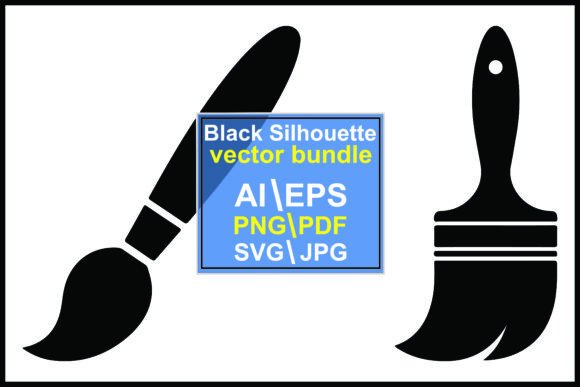
- Flat Brushes: Characterized by their rectangular ferrules and straight bristle ends, flat brushes in silhouette form represent structure, coverage, and bold strokes. They are frequently used in designs related to house painting, broad artistic expression, or architectural rendering. Visually, they provide strong horizontal or vertical lines that can anchor a layout.
- Round Brushes: With tapered points and cylindrical bodies, round brushes signify detail, precision, and fluidity. In vector collections, these shapes introduce organic curves and dynamic movement. They are ideal for illustrating fine art techniques, calligraphy services, or cosmetic applications where softness and accuracy are key messaging points.
- Fan and Specialty Brushes: Less common but highly evocative, specialty tools add texture and niche relevance. A fan brush silhouette immediately suggests blending, foliage, or textured effects. Including these in a design signals specialized knowledge and caters to audiences familiar with advanced artistic techniques.
Navigating File Formats for Optimal Workflow Integration
Acquiring a silhouette vector bundle involves managing multiple file types, each engineered for specific software environments and end-use scenarios. A professional-grade collection containing JPG, PNG, AI, EPS, SVG, and PDF formats ensures compatibility across the entire creative ecosystem. Understanding when to deploy each format prevents workflow bottlenecks and maintains asset integrity.
Vector Source Files: AI and EPS
Adobe Illustrator (AI) and Encapsulated PostScript (EPS) files represent the master sources for any vector asset. These formats preserve editable anchor points, layers, and path information. For designers intending to modify the shape of a paintbrush, combine multiple tools into a new composite icon, or adjust stroke weights, these are the mandatory starting points. EPS files, in particular, offer broader backward compatibility, making them safer for sharing with clients or printers who may use older software versions or non-Adobe platforms like CorelDRAW or Affinity Designer.
Web and UI Standards: SVG
Scalable Vector Graphics (SVG) have become the industry standard for web implementation. Unlike AI or EPS, SVGs are XML-based text files that render natively in browsers without plugins. When featuring black paintbrushes on white background in a website header, app interface, or interactive infographic, SVG ensures razor-sharp rendering on retina displays while keeping file sizes minimal. Additionally, because SVG code is accessible to CSS and JavaScript, developers can animate these brushes, change colors on hover, or integrate them into responsive design systems dynamically.
Raster Derivatives: PNG and JPG
While vectors are superior for editing, raster formats remain essential for quick previews and non-design contexts. PNG files with transparent backgrounds allow users to drag and drop paintbrush silhouettes directly into presentation software, word processors, or basic photo editors without worrying about white bounding boxes. JPG files, conversely, serve as reliable thumbnail references or placeholders in mockups. It is important to note that while these raster versions are convenient, they lack the scalability of their vector counterparts and should generally be reserved for fixed-size applications.
Document Integration: PDF
Portable Document Format (PDF) files bridge the gap between design and documentation. Vector-based PDFs retain editability in professional software while displaying consistently in universal viewers. This format is particularly useful for educators creating worksheets, researchers compiling visual appendices, or businesses preparing print-ready catalogs. Embedding black paintbrush vectors in a PDF ensures that the graphics remain sharp regardless of zoom level or printing resolution.
Practical Implementation Across Diverse Industries
The utility of a painting tools vector bundle extends far beyond traditional art supply marketing. The abstract nature of silhouettes allows these assets to function as metaphors and functional icons in unexpected sectors.
Educational Resource Development: Teachers and curriculum designers frequently require clear, distraction-free imagery to illustrate art history lessons or technique tutorials. Black paintbrushes on white background provide neutral visuals that do not compete with instructional text. Because these vectors can be resized to fit worksheet margins or projected onto smartboards without pixelation, they support diverse learning environments from kindergarten art classes to university-level design theory courses.
Cosmetic and Beauty Branding: Makeup application shares significant terminology and tool morphology with traditional painting. Round brushes, fan brushes, and flat applicators are central to beauty marketing. Silhouette vectors of these tools offer a sophisticated, minimalist aesthetic that aligns with luxury branding trends. Unlike photographic product shots which may date quickly, vector silhouettes remain timeless and can be easily adapted to match seasonal color palettes.
Home Improvement and DIY Content: For bloggers, influencers, and retailers in the home renovation space, paintbrush icons serve as universal wayfinding symbols. They categorize content, indicate tutorial difficulty levels, or highlight product features in comparison charts. The high contrast of black tools on white backgrounds ensures these indicators remain visible even when overlaid on busy photographic backgrounds or printed in grayscale instruction manuals.
Asset Management and Technical Considerations
Professional asset libraries typically deliver these resources in a compressed ZIP archive to facilitate efficient transfer and organization. Proper extraction and management of this bundle is the first step in maintaining an orderly digital workspace. Users should employ standard decompression utilities such as WinZip, WinRAR, or native operating system tools to extract contents. Double-clicking the archive usually initiates this process automatically on modern systems.
Once extracted, establishing a logical folder structure prevents future confusion. Separating source vectors (AI, EPS, SVG) from raster derivatives (PNG, JPG) allows designers to quickly locate the appropriate file type without sifting through duplicates. Naming conventions should reflect the content descriptively; renaming generic filenames like "brush_01.svg" to "flat-brush-large.svg" significantly improves searchability within asset management platforms or operating system file explorers.
Licensing flexibility represents another critical consideration. Assets designated for unrestricted use empower creators to incorporate black paintbrushes on white background into commercial products, client deliverables, and personal projects without attribution anxiety. This freedom is particularly valuable for agencies handling multiple accounts or entrepreneurs developing proprietary merchandise. However, responsible usage still applies; while the individual brush silhouettes may be freely used, reselling the unmodified bundle itself typically violates standard licensing terms. Understanding this distinction protects both the creator's intellectual property and the user's commercial interests.
Compositional Techniques for Silhouette Integration
Successfully incorporating these tools into a design requires thoughtful composition. Negative space plays a crucial role when working with solid black forms on white fields. Designers should avoid clustering too many brushes together, as this creates visual mass that overwhelms adjacent content. Instead, distributing elements with intentional breathing room maintains the elegance inherent in silhouette art.
Rotation and scaling introduce dynamism to static vector shapes. A perfectly vertical paintbrush reads as clinical or catalog-like, while a 45-degree angle suggests action and creativity. Experimenting with overlapping transparent layers can also create depth without sacrificing the silhouette aesthetic. By adjusting opacity or using blend modes, designers can simulate the layering of actual brushstrokes while retaining the clean, scalable benefits of vector graphics.
Color adaptation deserves equal attention. While black on white provides maximum contrast, contextual harmony often requires tonal adjustment. Dark gray silhouettes may feel less aggressive in minimalist layouts, while colored versions should consider color psychology and accessibility standards. Testing these variations across intended output mediums—screen, print, embroidery, or laser cutting—ensures the chosen treatment performs reliably in real-world conditions.