3D Honeycomb Pen Holder, Desk Organizer: Elevating Workspace Efficiency Through Geometric Design
Clutter is the silent enemy of productivity. For anyone spending hours at a desk, the chaotic jumble of pens, styluses, markers, and small tools creates visual noise that subtly drains mental energy. The 3D Honeycomb Pen Holder, Desk Organizer addresses this friction point not just as a storage vessel, but as a deliberate design intervention. By leveraging the hexagonal geometry found in nature, this organizer transforms a mundane utility item into a functional piece of modern art. It is more than a place to put a pen; it is a system for reclaiming desktop real estate and establishing a sense of order through biomimetic engineering.
The Practical Geometry of Hexagonal Storage
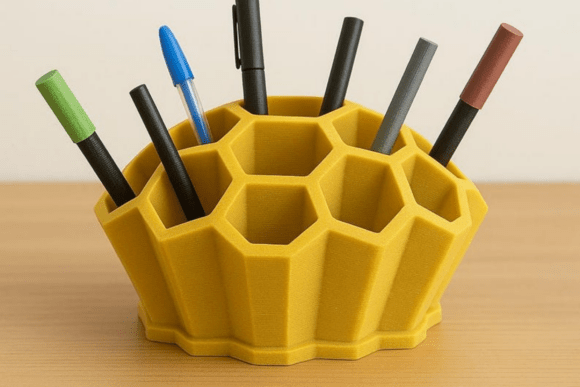
Most traditional pen holders are cylindrical or rectangular. While functional, these shapes often waste space or fail to segregate items effectively. Pens slide against each other, tips get damaged, and smaller items like erasers or USB drives disappear into the void. The honeycomb structure changes this dynamic entirely. Each hexagonal cell acts as an individual silo, providing dedicated housing for specific tools. This separation prevents ink transfer between markers and protects delicate nibs from bending against heavier objects.
From a spatial perspective, hexagons tessellate perfectly. Unlike circles, which leave gaps when grouped, or squares, which can feel rigid, the honeycomb pattern maximizes density without sacrificing accessibility. When you download the STL file for this 3D Honeycomb Pen Holder, Desk Organizer, you are acquiring a layout that offers high capacity within a compact footprint. The angled walls also make retrieval easier; your fingers naturally guide into the open cells without fumbling, creating a tactile experience that feels intuitive rather than mechanical.
Real-World Applications Across Different Disciplines
The true value of this organizer emerges when applied to specific workflows. A generic cup holds things; a specialized organizer supports a process. Here is how different users integrate this honeycomb design into their daily routines.
For Digital Artists and Illustrators
Creative professionals often manage a hybrid workflow involving both analog and digital tools. A tablet stylus, replacement nibs, blending stumps, and fine-liners need to coexist peacefully. The varying depths achievable in 3D printing allow for customization where deeper cells hold taller brushes while shallower ones keep erasers and sharpeners visible. For illustrators, having a designated spot for every tool reduces the cognitive load of searching mid-flow. The aesthetic alignment with creative workspaces also matters; the organic, mathematical beauty of the honeycomb complements the artistic environment better than mass-produced plastic bins.
For Students and Academic Researchers
Study spaces are often cramped dorm desks or shared library tables where efficiency is paramount. Students dealing with color-coded note-taking systems benefit immensely from the segmented nature of the honeycomb design. Highlighters, gel pens, and mechanical pencils can be sorted by function or subject. Because this is a 3D printable STL file, students can print multiple units that interlock or stack, adapting their organization system as their course load changes. The durability of materials like PLA or PETG ensures the organizer survives being tossed into backpacks or shuffled across study hall tables throughout the semester.
For Makers and Electronics Hobbyists
Workbenches are notorious for losing small components. While larger bins handle hardware, precision tools require immediate access. Soldering iron cleaners, wire strippers, precision screwdrivers, and tweezers fit snugly in honeycomb cells. The open-top design allows for quick grab-and-go access during assembly tasks. Furthermore, makers appreciate the ability to modify the STL file before printing. Need a wider cell for a caliper? Simply scale that specific section in your slicer software. This adaptability makes the 3D Honeycomb Pen Holder, Desk Organizer a living part of the workshop ecosystem rather than a static accessory.
Corporate and Home Office Professionals
In professional settings, desk aesthetics signal competence and attention to detail. A sleek, minimalist honeycomb organizer serves as a conversation starter while maintaining strict utility. It organizes the "daily drivers"—fountain pens, business card holders, and reading glasses—keeping them upright and visible. For those practicing hot-desking or working in shared offices, a personalized 3D printed organizer marks territory and provides consistency in an otherwise transient environment. The modern geometric look bridges the gap between tech-forward minimalism and warm, natural patterns, fitting seamlessly into contemporary office decor.
Considerations for Printing and Material Selection
Acquiring the digital file is only the first step. Realizing the full potential of this organizer requires thoughtful preparation regarding fabrication. Since this is an STL digital file ready for 3D printing, the end result depends heavily on your printer settings and material choices.
- Infill and Wall Thickness: While honeycombs are structurally efficient, pen holders endure lateral force when inserting or removing items. Printing with at least three perimeter walls and 15-20% infill ensures the unit has enough weight to remain stable and won't crack under daily use. A lightweight print might tip over if loaded with heavy metal pens.
- Material Durability: Standard PLA works beautifully for indoor desk use and offers the widest color selection. However, if the organizer will sit in direct sunlight near a window or in a warmer environment like a workshop, consider PETG or ASA to prevent warping over time. Matte filaments tend to hide layer lines better than glossy ones, giving the honeycomb texture a more refined, ceramic-like appearance.
- Bridging and Overhangs: Depending on the specific STL design, some honeycomb angles may require support structures. Check the model preview in your slicer. If possible, orient the print to minimize supports inside the cells, as removing them from narrow hexagonal tubes can be tedious and may leave rough interior surfaces that could snag pen clips.
- Tolerance Testing: Before committing to a full-size print, measure your largest intended tool. Some designs prioritize standard ballpoints; if you use chunky markers or specialized drafting tools, verify the cell diameter in the CAD file or print a single-cell test piece first. Adjusting scaling globally affects wall thickness, so targeted modification is often superior to blanket resizing.
Balancing Aesthetics with Functional Limitations
It is important to approach this project with realistic expectations. The 3D Honeycomb Pen Holder, Desk Organizer excels at vertical storage and segmentation, but it is not a catch-all solution. Items with irregular shapes, such as scissors or tape dispensers, typically do not fit well in hexagonal cells. This organizer works best as part of a broader desk system, handling writing instruments and small accessories while other solutions manage bulkier items.
Additionally, the intricate geometry means cleaning requires a bit more effort than wiping down a smooth cylinder. Dust can settle in the corners of the hexagons. Regular maintenance with compressed air or a soft brush keeps the unit looking pristine. Despite these minor considerations, the trade-off is overwhelmingly positive. The psychological benefit of seeing tools organized in a pleasing, logical pattern contributes to a calmer, more focused mindset.
Ultimately, choosing to 3D print your own desk accessories represents a shift toward intentional ownership. Instead of accepting whatever organizational products happen to be available at the store, you are fabricating a solution tailored to your specific needs and aesthetic preferences. The honeycomb pen holder stands as a testament to the idea that functional objects should also be sources of inspiration. Whether you are upgrading a home studio, organizing a student desk, or refining a professional workspace, this digital file provides the blueprint for a cleaner, more efficient, and visually engaging environment. Download the STL, fire up your printer, and transform your desk from a cluttered surface into a curated command center.